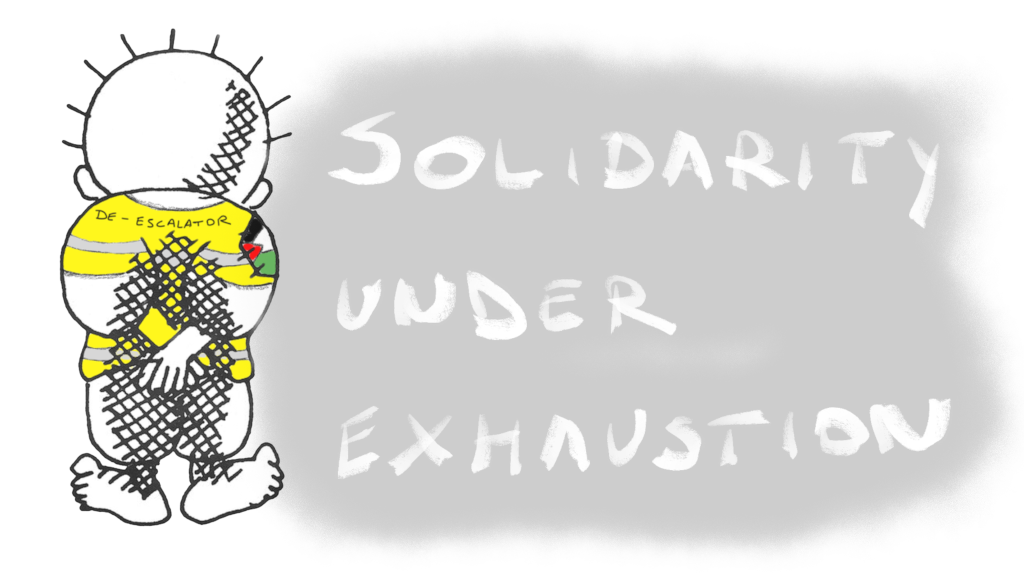
This postdoctoral project examines how solidarity navigates exhaustion, despair, and repression while sustaining infrastructures of care and imagination.
Since October 2023, organising in Belgium and Finland has shifted from sporadic protests to sustained, confrontational action, forging new coalitions, tactics, and imaginaries. These shifts unfold amid exhaustion: organisers face burnout, publics are overwhelmed, and governments remain complicit through silence or alignment with Israeli policies. Here, solidarity is also endurance: activists sustain themselves emotionally and relationally when efficacy feels uncertain.
The project asks:
- How have organising practices in Belgium and Finland changed since October 2023?
- How do activists navigate despair and fatigue, and how do care, friendship, and vulnerability sustain endurance and resistance?
- How has state complicity reshaped activists’ political perspectives and democratic imaginaries?
Using ethnography, auto-ethnography, and collaborative workshops, the project advances four tracks: (1) everyday solidarity, (2) affective and ethical dimensions, (3) co-produced knowledge with activists, and (4) political imagination under state complicity.
Outputs include three peer-reviewed articles, an open-access edited volume, activist toolkits, and a multimedia website. Academically, the project advances scholarship on solidarity in social movements, feminist peace research, social movement studies, and decolonial work by theorising care, exhaustion, and despair as generative in activism. Socially, it strengthens activist networks by returning findings via resources, workshops, and talks.
Recognising emotional and relational labour as epistemically generative, it shows how solidarity is lived through fragile yet resilient practices of care, refusal, and endurance.
The grant of 202,600 euro for this project has been provided by the Kone Foundation.
The project will span 4 years, starting in March 2026.