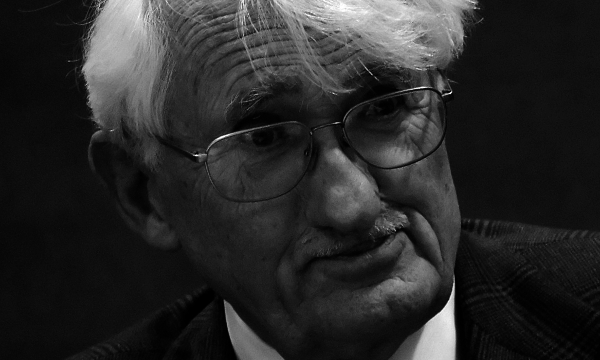
- Image source Wikipedia
A response to “Jürgen Habermas (96) committed himself tirelessly to democracy: ‘Europe has lost one of its most influential thinkers’” by Maurice Van Turnhout published in De Morgen on 15 March 2026
I just read Maurice Van Turnhout’s tribute to Habermas. I am by no means an expert on Habermas, he never interested me, but what I read compelled me to respond.
Jürgen Habermas died at the age of 96, and the tributes came quickly. Germany’s chancellor called him one of the most influential thinkers his country had produced. Former students recalled his energy, his sharpness, the late evenings in Frankfurt restaurants where democracy was debated until everyone had gone home. Emmanuel Macron, we are told, regularly called him for advice on the future of Europe.
It is a fine tribute for a fine reputation. It just leaves out the most important thing.
In November 2023, while Israel’s bombing campaign over Gaza was killing tens of thousands of civilians, Habermas put his name to a statement declaring that Germany must stand unconditionally behind Israel, and that Israeli military operations could not, by definition, be described as genocidal in intent. His own Frankfurt School colleagues were appalled. They called Gaza his “blind spot.” That framing, warm, forgiving, the kind of thing you say about the minor failing of a great man, deserves to be challenged. What Habermas did in 2023 was not a blind spot. It was the logical conclusion of a lifetime of looking away.
Habermas’s thesis was that the Holocaust was unique, an exceptional event in human history that placed a permanent and non-negotiable moral obligation on Germany. That was not necessarily wrong. But it was always incomplete. Because the Holocaust was not exceptional in the history of the world. It was exceptional in the history of Europe. What shocked Europeans was not that mass murder was something new, but that a colonial method, the systematic extermination of a people deemed subhuman, had been turned inward, applied to Europeans themselves.
The Martinican poet Aimé Césaire said it decades ago: what Europe could not forgive Hitler for was not the crime against man as such, but the crime against the white man, the application to Europe of “colonial methods which until then had been reserved exclusively for the Arab, the Indian and the African peoples.” Habermas never seriously engaged with this argument. His entire ethical edifice rested on an exceptionalism that, honestly examined, collapses.
The narrowing of the concept of genocide was itself a political act, and a colonial one. When Raphael Lemkin, the man who coined the word genocide, pushed for the 1948 UN Convention to also cover cultural genocide, it was the Western nations that blocked him. The United States led the charge, demanding the definition be confined to overt mass killing. Britain, France, the Netherlands, Canada, Australia, all lobbied to keep their own colonial practices beyond the law’s reach. The legal framework that makes the Holocaust appear exceptional was designed precisely to exclude the genocides that Western states were simultaneously committing against Indigenous peoples around the world.
This is the definition Habermas inherited. This is the definition he defended. When he declared that Israel’s operations in Gaza could not by definition be genocidal, he was not applying a neutral standard. He was applying a standard that had been built from the outset to keep exactly this kind of violence beyond scrutiny.
Palestinians know a different history. My own research, based on years of fieldwork, interviews and testimony, documents what Israel has been doing not since October 2023, but from before the state even existed. The 770,000 Palestinians expelled during the 1948 Nakba were not a founding trauma followed by conflict. They were the opening move of an ongoing structure. Scholars call it genocide by attrition: not the spectacular mass killing that fits the European definition, but the slow, grinding, cumulative destruction of a people through forced displacement, denial of healthcare and food, demolition of homes, erasure of cemeteries, suppression of language, culture and knowledge. The evictions in Sheikh Jarrah. The Mamilla Cemetery in Jerusalem, one of the oldest in the world, converted by the Zionists into parking lots and, with an irony almost too cruel to be accidental, a Museum of Tolerance. Decades of administrative detention without charge. The systematic assault on Palestinian bodies, education and memory.
Gaza since October 2023 is not a departure from this history. It is its acceleration. What was slow became fast. What was structural became spectacular. And Habermas, the great champion of the forceless force of the better argument, took the side with the bombs.
Here lies the sharpest irony. Habermas spent his life arguing that legitimate norms can only emerge from open dialogue in which all those affected participate as equals. No voice may be structurally excluded. The “forceless force of the better argument,” that phrase from his Strukturwandel der Öffentlichkeit, was meant to mean that power could not simply override reason, that those subjected to a decision have the right to participate in making it.
And yet Palestinian voices were simply absent from his reasoning on Gaza. The people being dispossessed, imprisoned, bombed and starved did not appear as subjects with a voice in his moral consideration. They appeared, when they appeared at all, as a problem to be managed. His communicative community was in practice a European and Israeli one. A theory of discourse ethics with a built-in colonial exclusion is not a universal theory. It is European philosophy in a universalist costume.
Edward Said showed us decades ago that Zionism reproduced the founding logic of European colonialism: the narrative of the empty land, the denial of the indigenous population, the conviction that modern European civilisation was being brought to a place that did not yet fully exist. Habermas apparently never took Said seriously. The Frankfurt School’s postcolonial record is, to put it charitably, thin. The public sphere that Habermas celebrated, born in the salons and coffeehouses of eighteenth-century Europe, was built in part on wealth drawn from people who were never invited through the door.
The tribute calls him the conscience of Germany. Perhaps that is precisely right. Germany’s conscience has meant, for seventy years, Holocaust memory instrumentalised as a reason not to think, a moral trump card that closes down ethical reasoning rather than enabling it. Support for Israel has become, within this framework, a categorical obligation immune to empirical revision. What Israel actually does, to actual Palestinians, in actual time, is simply bracketed out. The debt is owed to an idea of Israel, not to its reality.
Habermas was not a bad man. He was a man formed entirely within a tradition that had never genuinely universalised its moral commitments, and who mistook the limits of that tradition for the limits of moral thought itself. His entire career was a warning against exactly this kind of particularism. He just could not see it in himself.
The teacher of Germany. He spent decades teaching the lesson of the Holocaust, and never once asked what the dead of the rest of the world might have to teach him.